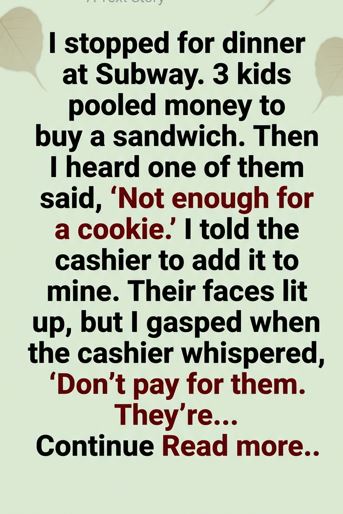
I stopped for dinner at Subway.
Three kids were standing near the counter, quietly counting a handful of crumpled bills and coins between them.
They pooled everything they had and ordered one sandwich.
Then one of them looked at the cookie display and whispered,
“Not enough for a cookie.”
I told the cashier, “Add three cookies to mine.”
The kids looked at me.
Their faces lit up instantly.
One of them smiled so wide that I could see the missing tooth in his mouth.
But just as the cashier reached for the cookies, she leaned toward me and whispered,
“Don’t pay for them.”
I froze.
“What?”
She glanced at the three children.
“They’re…”
She paused, lowering her voice.
“They’re not homeless.”
I looked at her, confused.
“They come here almost every evening,” she continued. “They buy one sandwich and split it between the three of them.”
I looked back at the kids.
One was carefully dividing the sandwich into three equal pieces.
He used the edge of a napkin to make sure each piece was the same size.
The smallest boy noticed me watching.
He smiled politely.
“We’re okay,” he said.
That sentence hit me harder than anything else.
They weren’t asking for money.
They weren’t begging.
They were simply doing what children do when they have learned far too early that some things have to be shared.
I asked the cashier why they always came here.
She sighed.
“They live with their grandmother a few blocks away. Their mother works nights. Their grandmother doesn’t have much.”
She paused.
“But here’s the part that gets me.”
“What?”
“They never complain.”
Apparently, whenever they had enough money for only one sandwich, they divided it three ways.
And whenever they had a little extra, they saved it.
Not for toys.
Not for candy.
For their grandmother.
“She likes chocolate,” the cashier said.
I looked at the three cookies sitting on the counter.
Then I looked at the kids.
“Actually,” I said, “make that four.”
The cashier smiled.
I bought three cookies for the children and one for their grandmother.
When I handed them over, the oldest boy stared at me.
“This one’s for Grandma,” he said.
“I know,” I replied.
He looked surprised.
“How did you know?”
I smiled.
“The cashier told me.”
He hugged the cookie box against his chest like it was something precious.
Then the youngest boy whispered,
“Thank you.”
I sat down for a few minutes and watched them eat.
They didn’t rush.
They divided everything carefully.
The middle child broke his cookie in half and gave part of it to his little brother.
I asked him why.
He shrugged.
“He likes the chocolate chips more than me.”
We all laughed.
Before I left, I quietly paid the cashier enough to cover several future meals for the three kids.
But I asked her not to tell them who had paid.
As I walked toward the door, I heard the oldest boy say,
“Someday, when we have enough money, we’re going to buy someone else dinner.”
I stopped.
I turned around.
He didn’t see me.
And somehow, that sentence stayed with me long after I left the restaurant.
Sometimes, kindness isn’t about how much you can afford to give.
Sometimes, it’s simply noticing that someone has less than you—and making their day a little easier.
And sometimes, the people who have the least are the ones who remind us how much we already have.