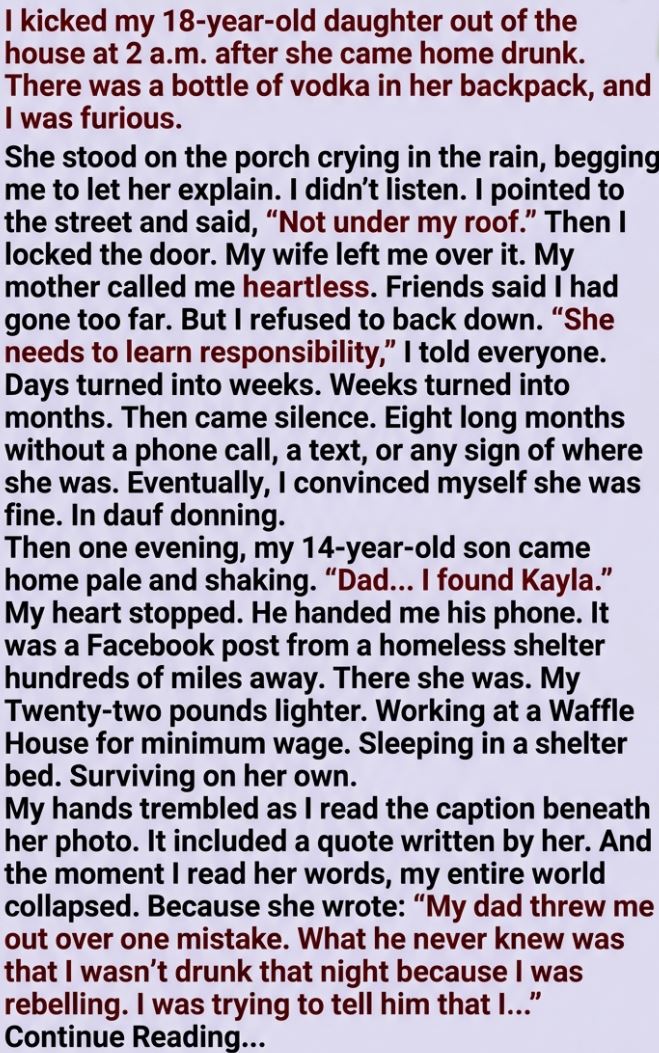
My hands trembled as I read the rest of her words. “I wasn’t drunk that night because I was rebelling. I was trying to tell him that I had just lost my best friend in a car accident.” I stared at the screen. The words blurred. I read them again and again. My son stood silently across from me. “Dad?” he whispered. I couldn’t answer. I remembered that night perfectly. The smell of alcohol. The bottle in her backpack. The tears running down her face as she stood on the porch. What I didn’t remember was asking a single question. Not one. I never asked where she’d been. I never asked why she was crying. I never asked what had happened. I saw the vodka, assumed the worst, and passed judgment. My son sat beside me. “Mom knew about the accident,” he said quietly. I looked up. “What?” He nodded. “Kayla’s friend Emily died that afternoon.” The room spun. My wife had tried to tell me. I remembered now. She had started saying something while I was yelling. I never let her finish. The next morning, I booked a flight. The homeless shelter was nearly a thousand miles away. The entire trip, I rehearsed what I would say. I’m sorry. I was wrong. Please come home. None of it felt like enough. When I arrived, a shelter worker recognized her immediately. “Kayla?” I nodded. “I’m her father.” The woman looked at me for a long moment, then said, “Wait here.” Twenty minutes later, my daughter walked into the lobby. For a second, I didn’t recognize her. She was thinner. Her clothes hung loosely from her frame. Dark circles sat beneath her eyes. But it was her. My little girl. The same little girl whose bicycle I taught her to ride. The same little girl who used to fall asleep on my shoulder during movies. She stopped walking when she saw me. The expression on her face wasn’t anger. It was disappointment. Somehow that hurt more. “Kayla,” I whispered. She folded her arms. “What are you doing here?” Every prepared speech disappeared. “I came to bring you home.” She laughed, but there was no happiness in it. “Home?” The word landed like a punch. “You mean the place where I got thrown away?” I couldn’t look her in the eye. “Kayla, I made a mistake.” She nodded. “Yeah.” The silence stretched between us. Finally, I asked the question I should have asked eight months earlier. “What happened that night?” For the first time, tears appeared in her eyes. “My best friend died.” My heart broke. “I found out that afternoon.” She swallowed hard. “We bought the vodka because we didn’t know what else to do. We were stupid and grieving.” I closed my eyes. Every word felt heavier than the last. “I was trying to come home and tell you.” Her voice cracked. “But before I could explain, you already decided who I was.” I couldn’t stop crying. Neither could she. For several minutes, neither of us spoke. Then I said the only honest thing I had left. “There isn’t a day that has gone by that I haven’t regretted what I did.” She looked at me carefully, as if trying to decide whether she believed me. “I slept in my car the first week,” she said. I felt sick. “I know.” “I was scared.” I nodded. “I know.” “I needed my dad.” Those four words shattered me. Because they were true. And because I wasn’t there. Eventually she sat beside me. We talked for hours about everything—the shelter, the jobs, the nights she went hungry, the strangers who helped her, and the strength she found because she had no choice. When evening came, I asked again, “Will you come home?” She thought for a long time. Then she surprised me. “No.” The answer hurt, but I understood. Trust isn’t rebuilt in a day. Sometimes it takes longer than it took to break. Before I left, she hugged me. The first hug in eight months. “I forgive you,” she whispered. Those words felt like a gift I didn’t deserve. Over the next year, we rebuilt our relationship slowly. Phone calls became weekly. Visits became monthly. Conversations became honest. Eventually she rented her own apartment, enrolled in community college, and began creating a future for herself. One afternoon, years later, she invited me to her graduation. As she crossed the stage, everyone applauded. I cried harder than anyone in the room. Not because of the diploma, but because she had made it despite everything. After the ceremony, she found me in the crowd and handed me a small envelope. Inside was a photograph of the two of us standing together, smiling. On the back she had written, “The worst night of my life taught me how strong I was. Having my father back taught me that people can change too.” I still carry that photo everywhere. Years later, when people ask me about parenting, they expect advice about discipline, rules, and responsibility. Instead, I tell them a different story. I tell them about a rainy night, a locked door, and a daughter standing on a porch begging to be heard. Then I tell them the lesson it took me years to learn: sometimes the most important thing a parent can do isn’t punish, lecture, or judge. Sometimes it’s simply listening for five more minutes. Because those five minutes might reveal a truth that changes everything. And if I could relive one moment in my entire life, it wouldn’t be my wedding day, my first promotion, or any great success. It would be that night. I would unlock the door, sit my daughter down at the kitchen table, and ask the question I should have asked from the beginning: “Kayla, what happened?” Because some mistakes cost money. Some cost pride. And some almost cost the people you love most.
I Threw My Daughter Out at 2 A.M. for Coming Home Drunk. Eight Months Later, One Sentence in a Facebook Post Destroyed Everything I Thought I Knew.